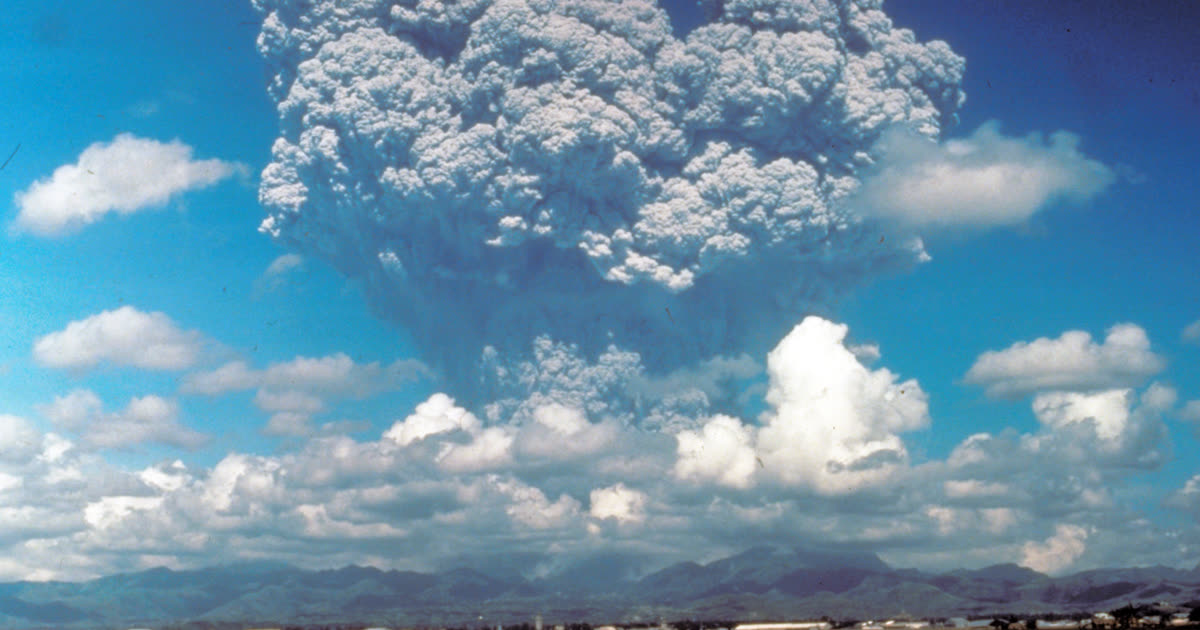
Historic volcanoes: eruptions that changed the climate and history
In 1815, a volcano in Indonesia exploded so violently that the following year became known in Europe and North America as “the year without a summer”. Harvests failed, it snowed in June and famine spread. No weapon, no war: dust and gases in the stratosphere.
How an eruption changes the climate
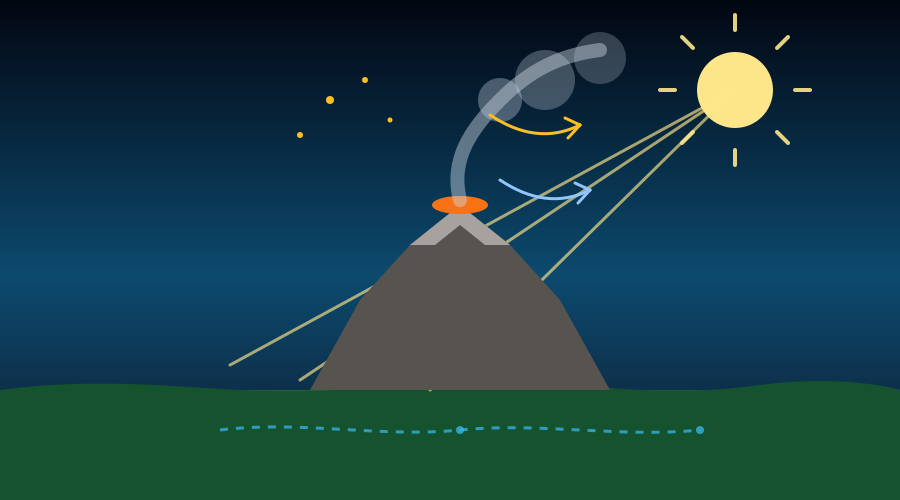
What changes the climate is not lava, but what reaches the stratosphere. Very large eruptions inject sulphur dioxide tens of kilometres up, where it becomes sulphate aerosols.
These aerosols reflect part of the sunlight back to space. The result is a cooling of a few tenths of a degree, lasting one to three years — and more intense sunsets, because light passes through more particles.
Larger particles fall out quickly. That is why small eruptions have almost no climate effect: only those reaching the stratosphere spread material across the planet.
Tambora, 1815: the year without a summer
Mount Tambora, on the island of Sumbawa in Indonesia, erupted in April 1815. It was the largest eruption of the last few thousand years, with explosivity index 7.
The ash column reached tens of kilometres. About 10,000 people died directly in the region; tens of thousands more died afterwards from famine and disease. The total estimate reaches 71,000.
In 1816, global temperature dropped and harvests failed in Europe, North America and China. It was the “year without a summer”. Historians link the episode to famine, migration and even to the emergence of sombre literature of the period.
| Eruption | Year | VEI | Climate effect |
|---|---|---|---|
| Laki, Iceland | 1783–84 | 4 (fissure) | Regional cooling; famine in Europe |
| Tambora, Indonesia | 1815 | 7 | “Year without a summer” in 1816 |
| Krakatoa, Indonesia | 1883 | 6 | ~0.5 °C cooling for a year |
| Pinatubo, Philippines | 1991 | 6 | ~0.5 °C cooling for two years |
Krakatoa, 1883: the loudest sound in history
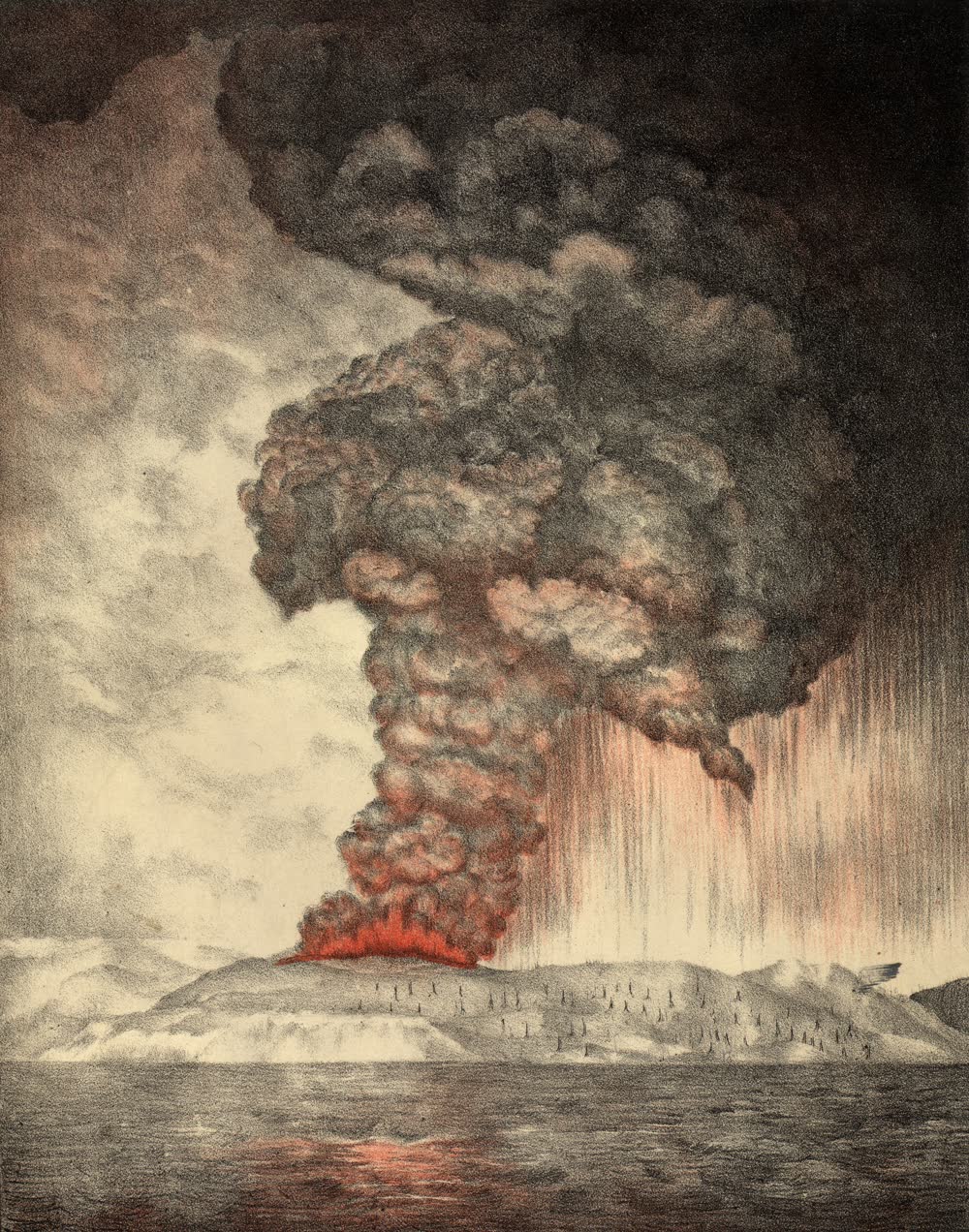
The Krakatoa eruption in August 1883 was heard about 4,800 km away — on Indian Ocean islands and in Australia. It is considered the loudest sound ever recorded.
Caldera collapse generated tsunamis up to 30 metres that struck Java and Sumatra. About 36,000 people died, most from the tsunami, not the eruption.
Dust in the stratosphere produced red sunsets seen worldwide — and there are records of period paintings with unusually coloured skies.
Laki, 1783: the eruption that killed slowly
Laki was not a single explosion but a 27 km fissure that released lava and gas for eight months. The explosivity index was low, but the volume of sulphur dioxide was enormous.
In Iceland, dry fog and acid rain destroyed pastures and killed animals. About a fifth of the Icelandic population died from famine and disease in the following years.
In Europe, the summer of 1783 was unusually hot and hazy, and harvests failed. The episode is studied as an example of how a low-explosivity eruption can have a disproportionate human impact.
Pinatubo, 1991: the eruption science predicted
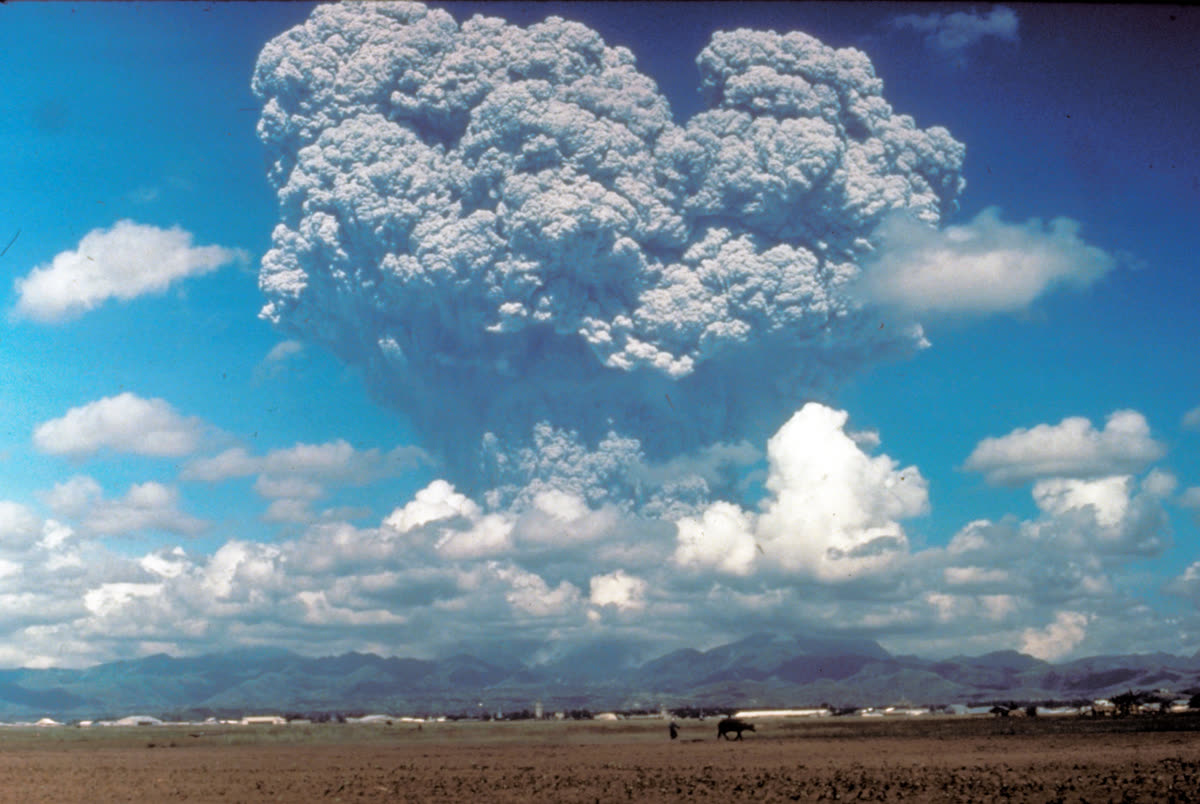
Pinatubo, in the Philippines, gave clear signs before exploding: earthquakes, ground deformation and rising gas emissions. Authorities evacuated tens of thousands of people.
The June 1991 eruption was one of the largest of the 20th century. About 800 people died, a low number for an event of that size — largely because of the evacuation.
Sulphate aerosols in the stratosphere cooled the planet by about 0.5 °C for two years. The event became a reference for geoengineering and disaster response studies.
Vesuvius, AD 79: the record that founded volcanology
The eruption of Vesuvius in AD 79 buried Pompeii and Herculaneum. Pliny the Younger described the event in letters still used as a reference — including to name the “plinian” eruption type.
Pyroclastic flows at hundreds of degrees killed those who could not escape. Bodies preserved in ash allowed reconstructing moments of Roman daily life.
The case matters for another reason: it was the first time someone described an eruption in enough detail to compare with later events.
Hunga Tonga, 2022: the 21st-century eruption
The eruption of the submarine volcano Hunga Tonga–Hunga Ha’apai in January 2022 was different from all previous ones: much of the energy came from the interaction between magma and seawater.
The explosion generated a tsunami that crossed the Pacific, a shock wave that circled the planet and an unusual amount of water vapour in the stratosphere — which, unlike sulphate aerosols, may have a warming effect.
The event showed that shallow submarine volcanoes can be as dangerous as continental ones, and that monitoring must include the seafloor.
What these eruptions teach
First: the impact of an eruption depends on factors that do not appear in the VEI — gas composition, column altitude, duration and proximity to populated areas.
Second: evacuation works. The contrast between Pinatubo (with warning) and Tambora (without) is one of the best pieces of evidence that preparedness saves lives.
Third: the climate is sensitive. A few tenths of a degree of cooling were enough to change harvests and history. To understand the volcanic mechanism behind this, see the volcanoes guide.
How eruption strength is measured
The Volcanic Explosivity Index (VEI) runs from 0 to 8 and combines the volume of material ejected with the height of the eruption column. Each point represents about a tenfold increase in volume.
VEI measures the explosion, not the human impact. A VEI 4 eruption can kill more than a VEI 6 if it hits a densely occupied region or releases a lot of gas over a long time.
That is why Laki, at VEI 4, appears alongside Tambora, at VEI 7, in climate impact discussions. The scale describes the physical event; disaster depends on where and how it hits society.
| VEI | Volume | Example |
|---|---|---|
| 0–1 | Less than 0.001 km³ | Typical Hawaiian eruptions |
| 2–3 | 0.001 to 0.1 km³ | Frequent arc eruptions |
| 4 | 0.1 to 1 km³ | Laki (1783), Eyjafjallajökull (2010) |
| 5 | 1 to 10 km³ | Hunga Tonga (2022) |
| 6 | 10 to 100 km³ | Krakatoa (1883), Pinatubo (1991) |
| 7 | 100 to 1,000 km³ | Tambora (1815) |
| 8 | More than 1,000 km³ | Toba (prehistoric) |
Eruptions that changed human history
The Thera eruption in the Aegean, around 1600 BC, may have contributed to the decline of the Minoan civilisation. The exact date and impact are still debated, but the event is one of the most studied of antiquity.
In AD 536, a series of eruptions — possibly including Ilopango in El Salvador — darkened the sky for months. Chronicles describe a weak sun and poor harvests, and scientists found sulphate in ice cores from that period.
These cases show that the impact of an eruption can last years and cross continents. You do not need to be near the volcano to suffer the consequences.
What is still debated
Tambora’s climate impact is well documented, but its social effects are still studied. Famine, migration and epidemics overlapped in ways that are hard to separate.
In the case of AD 536, the exact identification of the responsible volcano remains open. Candidates include Ilopango and volcanoes in North America and Iceland; evidence from ice cores and tree rings is consistent but not conclusive.
The Thera eruption has had disputed dating for decades. A difference of a few decades changes the interpretation of its impact on the Minoan civilisation.
Frequently asked questions
What was the largest eruption in history?
Among historically recorded ones, Tambora in 1815, at VEI 7. Prehistoric eruptions such as Toba were larger but have no written record.
How does an eruption cool the planet?
By injecting sulphur dioxide into the stratosphere, which forms aerosols that reflect sunlight for months or years.
What was the “year without a summer”?
1816, the year after Tambora, with low temperatures and failed harvests in Europe, North America and Asia.
What is VEI?
The Volcanic Explosivity Index, a 0–8 scale based on material volume and eruption column height.
Which eruption killed the most people?
It depends on the criterion. Tambora caused about 71,000 deaths including famine and disease; Krakatoa about 36,000, most from the tsunami.
Does Brazil have historic volcanoes?
There are no recorded eruptions in Brazilian territory. The country has ancient volcanism, such as the Paraná basalt.