
Plate boundaries: divergent, convergent, and transform
Tectonic plates are neither static nor isolated. They meet at edges called plate boundaries, where most of the planet’s earthquakes, volcanoes, and major geological features are concentrated.
What are plate boundaries?
A plate boundary is the region where two lithospheric plates meet. The relative motion between them defines the type of boundary and the geological processes that occur there. There are three main types: divergent, convergent, and transform.
These boundaries are not perfect lines. They are deformation zones with faults, fractures, and rotated blocks. Most global seismic activity occurs in these zones, although earthquakes also occur in plate interiors.
Divergent boundaries: plates move apart
At divergent boundaries, two plates move in opposite directions. Hot mantle rises to fill the gap, partially melts, and forms new oceanic crust. This process is called seafloor spreading.
Most divergent boundaries are on the ocean floor, along mid-ocean ridges. On land, the best-known example is the East African Rift. Iceland also sits on the Mid-Atlantic Ridge and shows volcanic and seismic activity.
- Motion: plates move apart.
- Features: mid-ocean ridges, continental rifts, and basaltic volcanoes.
- Earthquakes: usually shallow and moderate in magnitude.
- Examples: Mid-Atlantic Ridge, East African Rift, Iceland.
Convergent boundaries: plates collide
At convergent boundaries, plates move toward each other. The result depends on the type of crust involved. When an oceanic plate meets a continental plate, the denser one sinks into the mantle in a process called subduction. This forms ocean trenches, volcanic arcs, and some of the largest earthquakes on Earth.
When two oceanic plates converge, island arcs form, as in Japan and the Philippines. When two continental plates collide, neither sinks completely; the crust folds and forms mountain ranges such as the Himalayas.
- Motion: plates move toward each other.
- Features: trenches, volcanic arcs, mountains, and subduction zones.
- Earthquakes: can be very deep and large.
- Examples: Andes, Japan, Himalayas, Mariana Trench.
Transform boundaries: plates slide past each other
At transform boundaries, plates slide laterally past one another without significant crust creation or destruction. Friction between rocks can accumulate stress for long periods and release it in shallow, potentially destructive earthquakes.
The San Andreas Fault in California is the most famous example. The North Anatolian Fault in Turkey is another important transform boundary that has produced devastating earthquakes.
- Motion: lateral sliding.
- Features: transform faults, basins, and ridges.
- Earthquakes: shallow, sometimes very destructive.
- Examples: San Andreas, North Anatolian Fault, Alpine Fault in New Zealand.
Comparing the three types
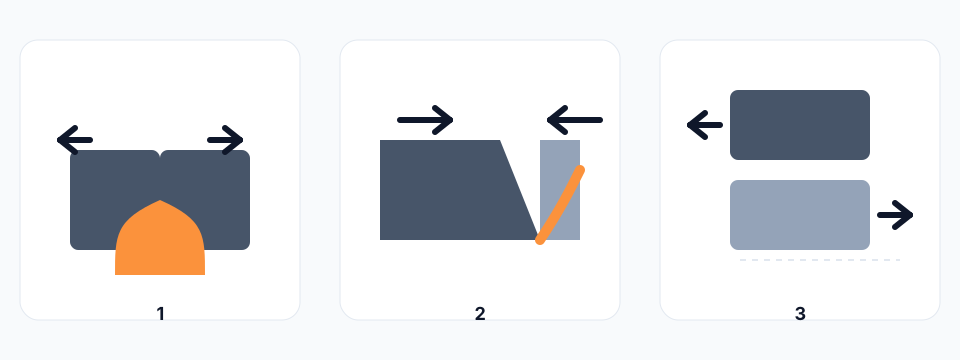
| Type | Motion | Typical features | Seismicity |
|---|---|---|---|
| Divergent | Moving apart | Ridges, rifts, new crust | Shallow, moderate |
| Convergent | Moving together | Trenches, volcanoes, mountains | Shallow to deep, high magnitude |
| Transform | Lateral sliding | Faults, basins | Shallow, can be destructive |
How to recognize them on the 3D map
On the interactive map, glowing lines represent the PB2002 plate boundaries. Clicking a plate shows its approximate area and the countries it covers. Selecting a country shows the plates beneath its territory.
Notice that boundaries do not always match continental coastlines. The South American Plate, for example, includes part of the Atlantic Ocean, and the Pacific Plate covers a vast oceanic area.
Does Brazil have a plate boundary?
Brazil is in the interior of the South American Plate, far from active edges. No plate boundary runs through the country. Nevertheless, ancient faults can be reactivated by regional stress and generate intraplate earthquakes.
Brazil is therefore not immune to tremors, but it does not have the same activity pattern as regions such as the Andes or the Ring of Fire.
Frequently asked questions
Which boundary type causes the largest earthquakes?
Convergent boundaries, especially subduction zones, produce the largest earthquakes ever recorded. The interface between plates accumulates enormous stress and can rupture over hundreds of kilometers.
Why is the Himalaya still growing?
The collision between the Indian and Eurasian plates continues to push the crust upward. The Himalaya and the Tibetan Plateau are the result of this process, which also generates earthquakes in the region.
Which type of boundary is Brazil on?
Brazil is not on an active plate boundary. Most of the country lies in the interior of the South American Plate, which explains the absence of large subduction earthquakes.