Tsunamis: how they form, how fast they travel, and how to stay safe
A tsunami is not a single giant wave but a series of waves that can travel thousands of kilometers. Understanding how it forms and behaves is essential for recognizing warning signs and acting quickly.
What is a tsunami?
A tsunami is a series of ocean waves generated by an abrupt displacement of a large volume of water. Earthquakes are the most common cause, but landslides, volcanic eruptions, and meteorite impacts can also generate tsunamis.
In the open ocean, the waves have small amplitude and may go unnoticed by ships. As they approach the coast, depth decreases, speed drops, and wave height increases. This process is called coastal amplification.
How an earthquake generates a tsunami
To generate a significant tsunami, an earthquake must occur on the seafloor and cause vertical displacement of the ocean floor. This displaces a column of water that propagates as a wave.
Being a large earthquake is not enough. Lateral, very deep, or low-displacement events may generate small or no tsunamis. The combination of magnitude, depth, fault mechanism, and bathymetry is decisive.
Speed and propagation
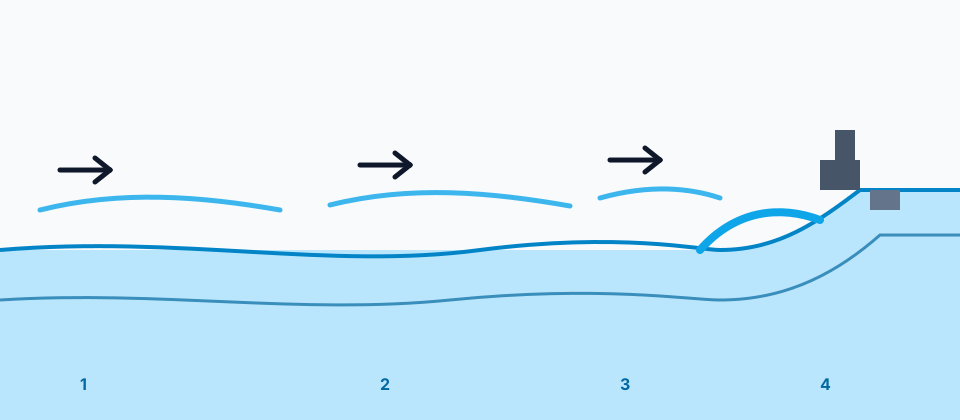
In deep water, a tsunami can travel at about 700–800 km/h, close to the speed of a commercial jet. A Pacific event can therefore reach distant coasts within hours.
Speed depends on water depth. In shallow areas, the wave slows and grows taller. Arrival time and height vary greatly with the coast, underwater topography, and wave direction.
- Open ocean: long waves, low amplitude, high speed.
- Coast: slowing, increased height, strong currents.
- Repetition: the first peak may not be the largest; the series can last for hours.
Natural warning signs
In addition to official alerts, natural signs can indicate an imminent tsunami: strong, prolonged shaking, an abnormal retreat of the sea, a loud roar like a train or plane, and sudden changes in wave behavior.
A receding sea is not a guarantee that a tsunami will come, but it is a risk sign. Never go to the beach to watch; the wave can arrive within minutes.
Warning systems
The Pacific Tsunami Warning System, coordinated by NOAA, monitors earthquakes and tides in real time. DART buoys detect pressure changes on the seafloor, and coastal stations measure sea-level variation.
Alerts are important tools but have limitations: not every tsunami is detected in advance, and arrival time can be very short near the epicenter. Public education and natural signs are therefore essential.
What to do
If there is an alert or natural sign, move away from the coast immediately and seek high ground, preferably above 30 meters or at least 3 km inland. If there is no time, go to an upper floor of a reinforced concrete building.
Do not return to the beach until authorities declare it safe. Waves can arrive in series for hours, and currents can be dangerous even after the first impact.
- Follow official evacuation routes and do not block traffic.
- Take only essentials and help people with reduced mobility.
- Stay away from coastal rivers and channels; tsunamis can travel through them.
- Wait for the official all-clear.
Is Brazil at risk of a tsunami?
Brazil has no Pacific coast and lies in the interior of the South American Plate, making the risk of local tsunamis very low. Distant events can still cause small sea-level variations, but not the impact seen in directly exposed regions.
Preparedness remains valid for anyone traveling to subduction areas such as Chile, Japan, Indonesia, or the U.S. West Coast. Knowing evacuation routes and warning signs is a simple and important measure.
Frequently asked questions
Does every offshore earthquake cause a tsunami?
No. A significant tsunami requires an offshore earthquake with large magnitude and vertical seafloor displacement. Lateral, deep, or low-displacement events may produce small or no tsunamis.
How fast is a tsunami?
In deep water, it can reach 700–800 km/h. As it approaches the coast, depth decreases, speed drops, and wave height increases.
Can Brazil be hit by a tsunami?
The risk of local tsunamis is very low because the country is in the interior of the South American Plate and has no Pacific coast. Distant events may cause small variations, but not the impact seen in directly exposed regions.